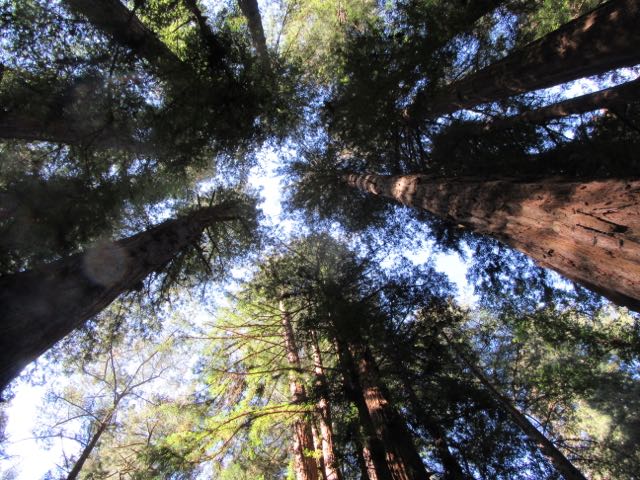
A ring of giants at Henry Cowell.
I recently found myself walking on the toes of giants. It’s possible to lose your balance when you gaze up to look at them. They sway, drawing circles in the sky, even without wind. I’ve missed these trees.
A ring of giants at Henry Cowell.
I recently found myself walking on the toes of giants. It’s possible to lose your balance when you gaze up to look at them. They sway, drawing circles in the sky, even without wind. I’ve missed these trees.
Maybe the moment that stands out most clearly in my mind, now, more than 25 years later, is the sunset on top the hill. In Western Ireland, sunlight lingers late in the evening in early July, then melts into a curtain of orange and red light that sinks slowly into the horizon (when it’s not raining). We had packed up tea and biscuits and grapes and took along the three, small, red-headed kids from our host family on the walk up the hill. Yellow light, bright red heads, and vivid emerald green carpet that stretched as far as the eye can see – that’s when I felt I was in Ireland. The photos, now yellowed with age, don’t do my memory justice.
That means it’s time to go back.
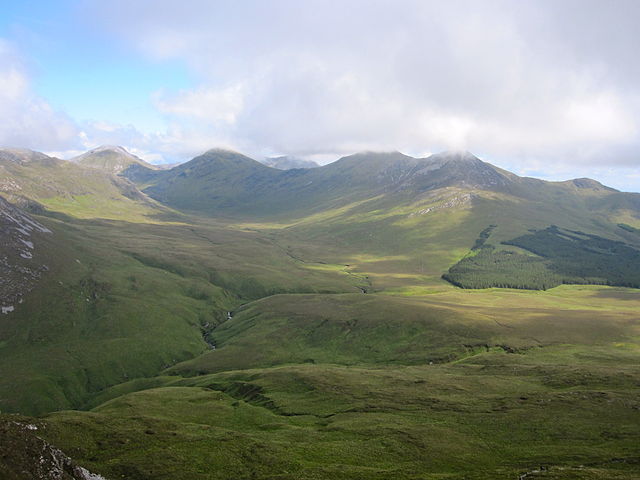
The hills of Connemara, Ireland [Source: Wikipedia CC BY-SA 3.0].
In the wake of Valentine’s Day earlier this month, I thought I’d say this: No need to panic, people – chocolate is not going extinct. Earlier this year, Business Insider published the horrific headline: Chocolate is on track to go extinct in 40 years. This juicy click-bait flooded Facebook news feeds, and probably sent many people on post-Christmas chocolate-feeding-frenzies I have to admit, at first glance, that headline sent a chill down my spine and spasms of pre-chocolate-withdrawl pain through my head – even as my conscious mind was forming the words ‘This is bogus!’. I remembered my experiences making chocolate in Ecuador, and what I’ve learned since, and started digging to back up my suspicions. (It didn’t take long, Snopes has already done the work.)
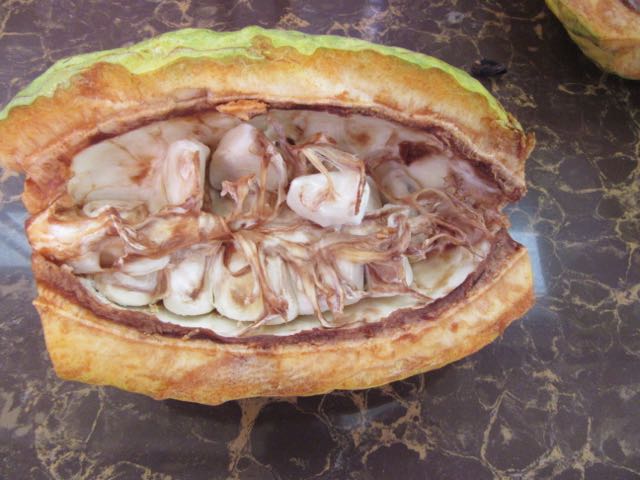
This is what chocolate (well, cocoa) looks like in it’s ‘natural’ state – right off the tree. The cocoa beans are covered in a slimy, tangy white coating that’s not all that different from a lot of tropical fruits that grow in pods with many seeds and have tangy centers.
In all stories, either a hero goes on a journey or a stranger comes to town. Sometimes the stranger sends the hero out on a journey. The stranger doesn’t have to be human. It can be a meteor hurtling toward earth, a tornado roaring across an open prairie, or a bear stalking a house. But it can be even more elusive than that. It could be an idea – one that flitters around until it settles on a host, then spreads like a virus.
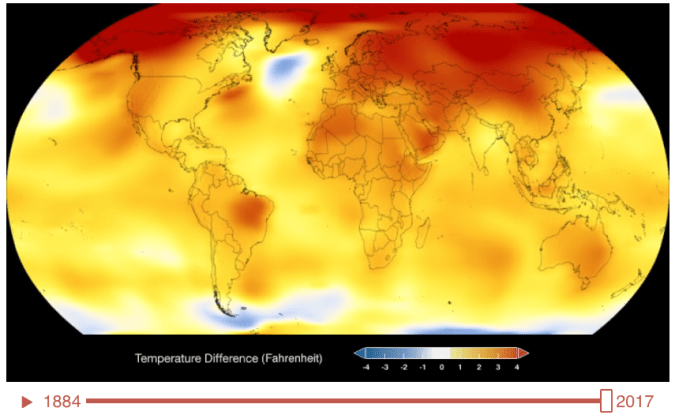
NASA’s Climate Time Machine lets you view global temperature anomalies going back to 1884. This snapshot shows anomalies in 2017.
We are all in the midst of a story right now – set on a global stage. The stranger is much more elusive than we could ever have thought. He flitters around the edge of our day-to-day consciousness. Some people see him clearly. Some deny that he could exist. He infiltrates our daily lives just beneath our consciousness, gradually unthreading the balance of the world we’ve built our lives on.
I have some news I haven’t shared with too many people yet: One year from today, I will be crossing the Drake Passage on my way to the Antarctic Peninsula with a group of about 80 other women scientists from around the world. It will be the culmination of a year-long professional program for women in STEMM (science, technology, engineering, math and medicine) called Homeward Bound. How cool is that?
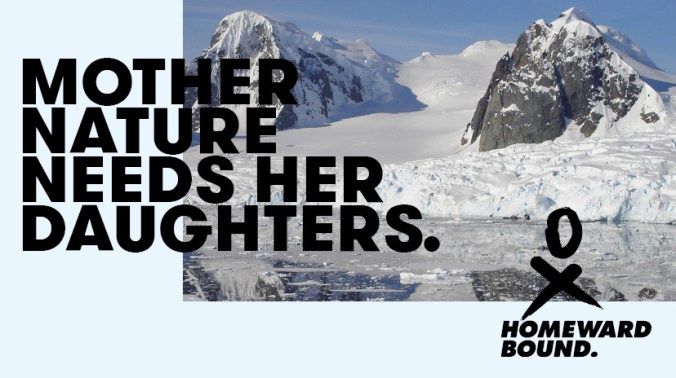
Homeward Bound is a major, not-for-profit initiative to equip 1000 women scientists over 10 years with skills in leadership and strategic decision-making in the context of global climate change science. The goals are not only to help women understand themselves as leaders, but also to help them understand how they can have a greater impact together – and then strategize ways to have an impact – to help nudge the world back onto a more sustainable path. My program starts online next month, and culminates in a 3-week expedition to Antarctica, sailing from Ushuaia, Argentina on December 31, 2018. My group will be the third cohort to go through the program. Continue reading
There are two things that seem to stand out the most when my students recount their memories of our trip to Ecuador (based on their collection of blog posts): the intensity of the Amazon, and the open friendliness of the the Agato community in Northern Ecuador.

Overlooking the community of Otavalo. Towering above the town is the ancient volcano, Imbabura. (A recent grass fire had turned the top of the volcano black.)
I wanted a component of our journey to Ecuador to include an experience of life in the rural Andes. Our agent at True Ecuador Travel recommended a 2-night homestay with the Agato people, near Otavalo. I had no idea what to expect. I visited Otavalo briefly on my first trip to Ecuador. It was a cloudy day. We took in the famed Otavalo market on a Saturday, and visited the rainy, socked-in volcanic crater of Cuicocha, just outside of town. Looking back on that first trip, it seems strange to me to think about how much I missed just passing through.

The Napo River winds through rolling hills of the Upper Amazon.
This is a place where your sweat never dries. After a day or two, your clothes develop a smell that make you wonder what’s happening to your body. It will take a couple of washings back home to nullify – but you have only one set of clean clothes left. Better to save them for the flight home.
The wide, dusty trail is packed with people and mule trains and slides 1000 feet down from the rim of a crater to an emerald blue lake. We were warned the trail would be challenging. But I was seduced by those glassy waters that ripple with new colors as the sky shifts and turns from blue to grey.
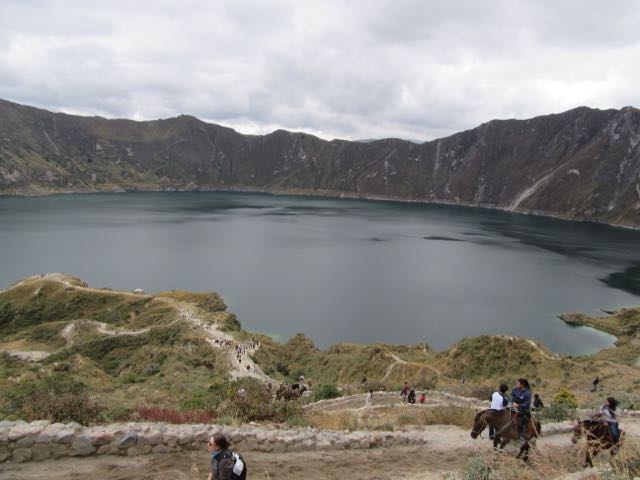
The moody looking waters of Quilotoa shift from blue to green to grey, depending on what’s happening in the sky.

One of the ‘cascadas’, or waterfalls, along a hike through the cloudforest in Mindo.
For a cloud forest, it was unusually sunny. This is what happens when you visit in the dry season. There’s still plenty of water, you just won’t find your feet sliding so much on muddy trails. This is my first time in Mindo. I can imagine the wet season well enough, having traveled to other cloud forests, such as Podocarpus in Southern Ecuador and Monteverde in Costa Rica. Either way, these types of places, usually nestled in the shadows of rolling green mountains, make you feel as though you’ve stepped out of time. That’s one of the reasons Mindo was on our syllabus.
I’m not a big city girl. Have I mentioned that before? I’m clearly out of my comfort zone in places where it takes more than 10 minutes to escape to something that resembles countryside. But I think I have something to learn from cities, about how people live en masse. With a net increase of about 200,000 people on this planet every day, living in cities is becoming difficult to avoid. This year, it was time to give Quito another chance.
Stepping out of your comfort zone is the theme of the first in our series of student blog posts on about our trip to Ecuador. UNCO meteorology student, Emily Ireland, explores this idea as she writes about her experiences in the Amazon. You can find her post on our Earth & Atmospheric Science blog site.
The Amazon is certainly a physical challenge for me, but I always feel at home in a forest – whichever forest that might be. Cities, however, have a way of getting to me like fingernails dragging along a chalkboard. Maybe they don’t so much push the edges of my comfort zone as rub raw the nerves that line the edge of that comfort zone.

The rooftops of Quito blanket the slopes of Volcán Pinchincha. View from El Panecillo, the bread-loaf shaped hill in the middle of the city, looking north over the colonial center.

