You might think that as a meteorologist who gets a rush from watching the summer sky light up from brewing storms that I would be excited to see lightning in my head. But no. I was just about as terrified as any of you would be.
On a Saturday last December I suddenly found a big circular jelly-fish-like blob floating in front of my face. The jelly fish had long, wispy tentacles, and floated in a sea of dust. I closed my eyes and shook my head, but it was still there when I opened my eyes. A few minutes later, the flashes began. Long curved bolts of lightning streaked across the peripheral vision in my left eyeball. With my eyes closed, I could see branching and arcing. With eyes open, it was like someone was flashing a bright light in my eyes.
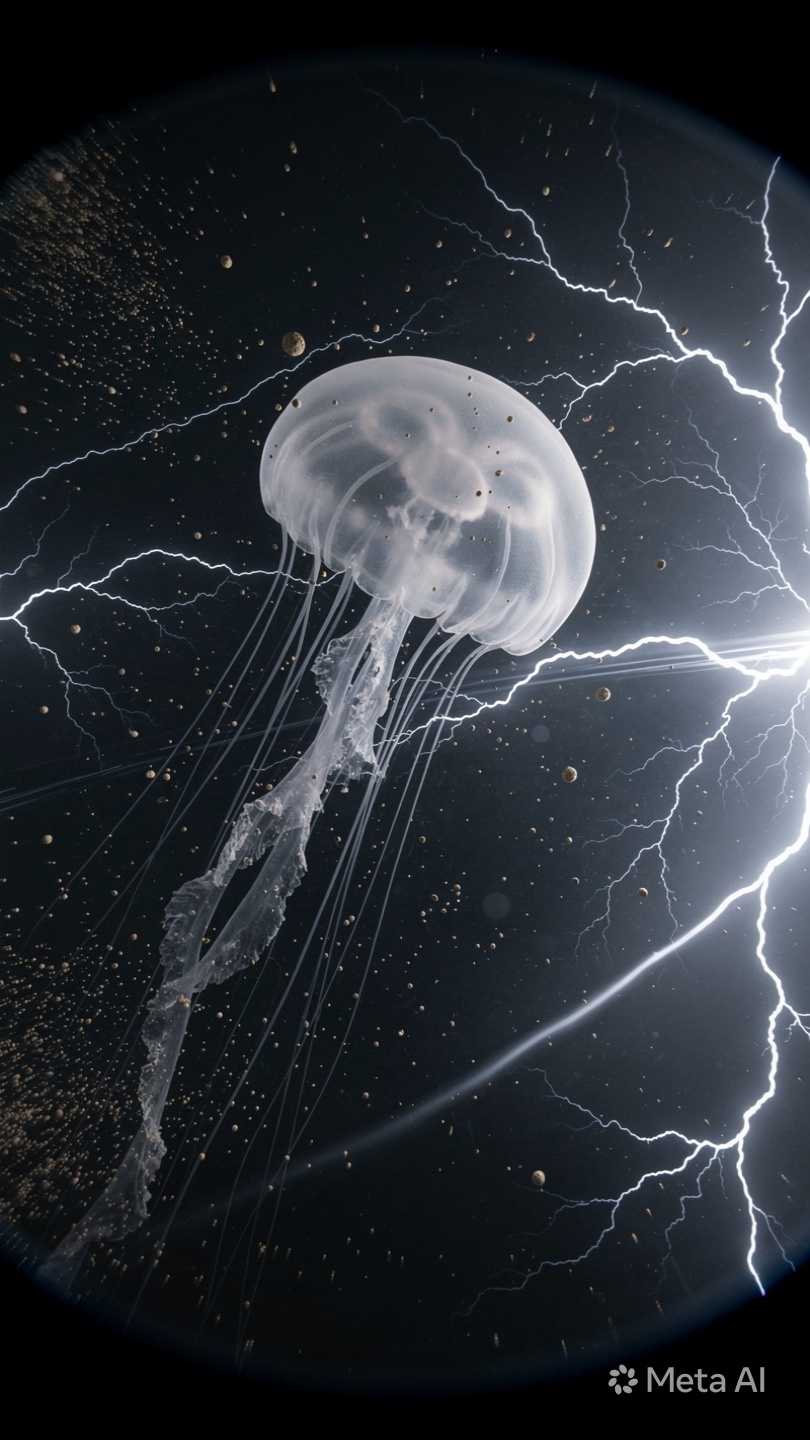
Two hours later, I was on the phone talking through the summer storm in my head with an emergency eye doctor. “Posterior vitreous detachment, PVD,” he said, “The vitreous gel in your eyeball is detaching from your retina.” The jelly fish and specks of dust were bubbles in the collapsed gel, and the flashes were caused by tugs on my retina. He went on to explain that while this process could be harmless, there was also a risk of retinal tears or detachment. This can cause vision loss if not repaired immediately. Because I wasn’t experiencing any loss of vision, he said we could wait until Monday morning for a full exam.
At the optometrist’s office, there was a full round of imaging of the inside of my eyeballs. Then a young optometrist (who looked to me like he was 15 years old, but was probably 30) took his flashlight and magnifying glass and searched every corner of my eyes. The good news: no retinal tears. And, as this young doctor put it, this change in the eyeball “is quite common in elderly people.” He backpedaled a bit when I gasped at the word elderly. “It can happen in slightly younger people too!”
Some of the flashing and the jelly-fish creature may never disappear completely. But my brain will eventually learn to block these things from my consciousness. Here I am, five months out: I still see occasional lightning strikes in the lower left corner of my eye. Ziggy (I named the jelly-fish) has faded a bit and lost his tail, and much of the dust has cleared. But there are a few persistent dots in my vision that make it look like I’m being followed by fruit flies.
I share this because (1) I never knew this kind of thing could happen without going blind (maybe you didn’t know that either) and (2) this biological event in my eyeball required me to look through new eyes. Or old eyes, as the case may be. The fruit fly spots lead me to question what I am looking at. And the flashes of light are like little explosions that distract me from what I really want to focus on.
This event has led me to question more broadly: to what extent do smoke screens and optical illusions impact our understanding of reality?

Whether smoke screens originate inside of us, or somewhere else — they can be really persistent, and make it hard for us to discern the true nature of things. We sometimes respond to them without looking deeper.
Sometimes the smoke can be beautiful. In the days after the PVD in my eyeball, Ziggy’s tail against a bright blue winter sky looked like a flock of birds in the distance, dancing to the shifting patterns of moving air. Ziggy’s wispy, etherial shape, can be hypnotic. It’s the same feeling you get from watching movement in an aquarium (after I got past feeling nauseous, it was rather fascinating).
I’ve always known that it’s impossible to view reality with true objectivity, even for trained scientists. This is why it is so important for us to not only understand our own lenses and screens, but the lenses and screens of others. I guess I’ve come to understand how important it is to build a shared version of reality that allows us to live peacefully, with respect for all of our differences.
This is that point in writing where I come back to my unwavering belief in the role of education in helping us build a shared reality that will sustain our civilization.
I recently came across a quote from an article Martin Luther King wrote in the Morehouse College campus newspaper in 1947:
A great majority of the so-called educated people do not think logically and scientifically. Even the press, the classroom, the platform, and the pulpit in many instances do not give us objective and unbiased truths. To save man from the morass of propaganda, in my opinion, is one of the chief aims of education. Education must enable one to sift and weigh evidence, to discern the true from the false, the real from the unreal, and the facts from the fiction.
The function of education, therefore, is to teach one to think intensively and to think critically. But education which stops with efficiency may prove the greatest menace to society. The most dangerous criminal may be the man gifted with reason, but with no morals.
Is there smoke in your vision, and what’s hiding behind that? Are your lenses of your own making, or has your brain been trained by algorithms that haunt you through your electronic devices? These algorithms are ever-adapting to your tastes, preferences and ideology. Are you sure they aren’t showing you a smokey view of the world?
Just a few thoughts, as we continue through on another year where we are called, on a daily basis, to discern the smoke screens from our physical reality.

A foggy Glenmere pond in Greeley, on a cool autumn morning.


Hope your “elderly” eyes clear up. The joys of aging!! Just wait! The “best” is yet to come! 🥰
LikeLike