Earth as 1989 Planet of the Year – We’ve come so far. Not.

(Alternative title: How I became a climate scientist). I’m back! After a long hiatus (also known as ‘spring semester’), I’m getting ready to publish a few posts that have been in the works for some time. This post, in fact, has probably been ‘in the works’ for more than 25 years.

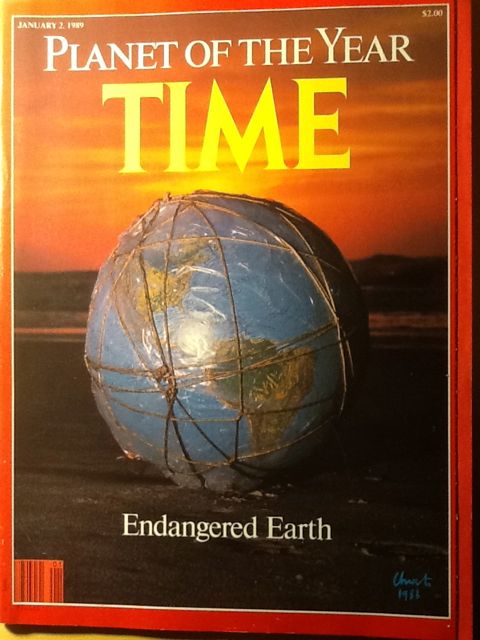
I recently gave a talk to a group of faculty at my university. I was asked to speak about my work, but also share a bit about how I got into climate science in the first place. I started with this cover from Time Magazine – January 1989.

2016_May17TimeMag

The cover of Time Magazine: January 2, 1989

This was the magazine cover that changed my life. Continue reading

El Último Hielero (The Last Ice Merchant)

My experiences in Ecuador forced me to think a lot about the intersection of culture and climate change. As a scientist, I often focus on the science, and steer away from discussion of political or social implications in my classes. But as I begin to better see the broad range of approaches and responses to changes in the environment and climate – ranging from outright denial (among supposedly educated people) that there are changes caused by humans, to complete ignorance that changes can occur – I’m getting a greater feel for the complexity of the problem, the complexity involved in addressing climate change – and it scares the hell out of me.

I love this little film that touches on cultural change in conjunction with climate change and adaptation. There is some great cinematography of the Andes in Ecuador, and it does a good job capturing a colorful culture. It’s also interesting to watch it again now that I’m home, in the midst of a Colorado winter, snow and ice right outside my door.

The Last Ice Man (with English subtitles)

There is another version without the subtitles at the movie’s homepage:

El Último Hielero

or at:

And, because climate scientists are people too, and it’s partly this fear for the world that drives us to do what we do, I wanted to end by sharing this website which hosts handwritten letters by scientists about their thoughts on climate change: Is this how you feel?

Transform Black Friday into Opt-Outdoors-Day – who’s on board?

2015_Nov24a

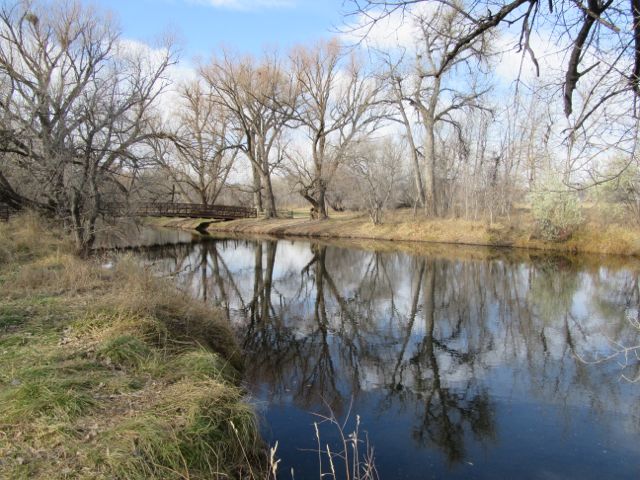
The Poudre River in Fort Collins, the day before Thanksgiving (or, rather, the day before Black Friday craziness begins)…Also the day before snow.

A couple of weeks ago the major outdoor retail chain, REI, announced that they would close their doors for Thanksgiving AND Black Friday, pay their employees, and encourage everyone to go out and enjoy the great outdoors. I think this is awesome, and I applaud this move. In fact, it makes me want to do all my Christmas shopping at REI, so maybe that was the point. But how many people really care?

Continue reading

Galapagos Part 3: Every shade of blue

IMG_5106

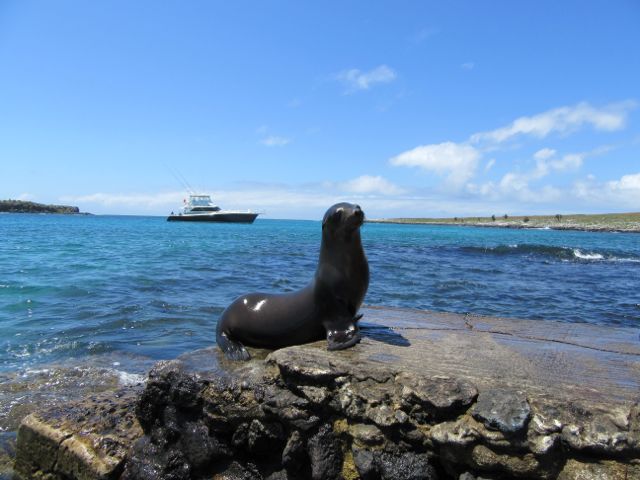
A juvenile sea lion awaits us on the dock of South Plaza’s Island, a small islet near the larger Isla Santa Cruz.

The Galapagos will always appear in shades of blue in my mind. While the drier island landscapes are painted in red and orange, or draped by lush, low forest canopies of green and yellow, those are simply accents against a pale blue sky, and deeper blue ocean. As the world here in the Northern Hemisphere gradually turns gold and red with autumn and a new school year is ramping up (well, ok, it’s been ramping up, and at this point, is going full speed ahead), I wanted to share one last set of Galapagos photos – shades of blue, some lush green forests, and quirky animals. Warm thoughts  and images to carry us through frigid days ahead (those of us who are winter-bound, anyway!) Continue reading

Galapagos Part 2: Bartolomé and North Seymour Islands

2015_0829a

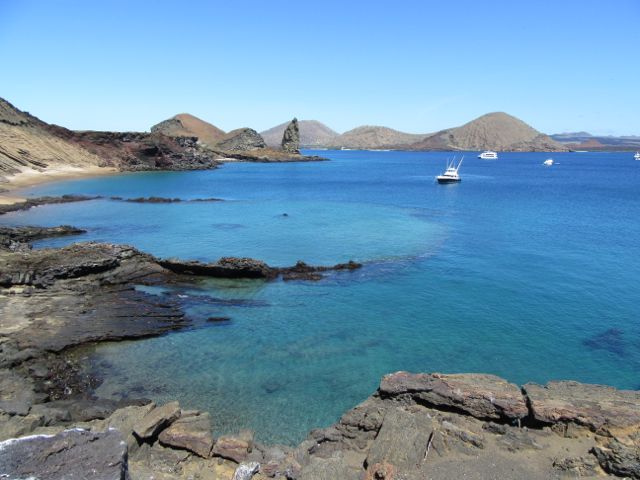
The colorful volcanic landscape of Isla Bartolomé in the Galapagos. The tall spire at the other end of the bay is ‘Pinnacle Rock’.

Imagine cruising into a tiny, protected bay, where the water laps gently on the rocks. Your vision is saturated with shades of blue, from the sky and the water, and shades of red, brown, grey and purple of volcanic cinder cone – you begin to feel like you’re on another planet. This is the small islet of Bartolomé in the Galapagos.

Continue reading

Pilgrimage to the Galapagos – First impressions

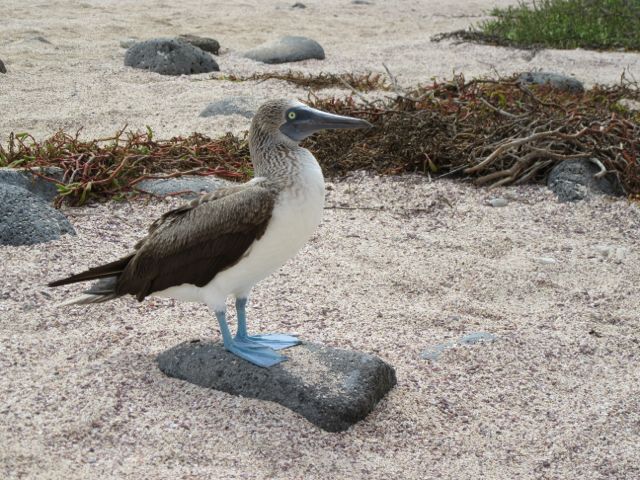
I felt as though I had walked into an episode of National Geographic. There it was, the famous blue-footed booby, less than 5 feet away, contentedly situated atop a small rock, and staring at us with alien eyes. He didn’t even blink as cameras shuttered and beeped. I’m guessing that this particular booby – and every booby on North Seymour Island – is already featured in thousands of photo albums and Facebook pages.

2015_0815i
The blue-footed booby, along with the giant tortoise, are the iconic creatures of the Galapagos. Although, iguanas and sea lions are prominently featured. And if you’ve ever studied biology, you’ve heard of Darwin’s finches. Yes – that’s right – the Galapagos Islands is the place that inspired Charles Darwin to formulate his theory of evolution. I’ve met enough people who don’t quite know where the Galapagos are, that this warrants a short geography lesson before I go much further. Continue reading

Favorite Spots in Cuenca #5 – Quinta Balzay

For those of you wondering about my silence on this blog lately, I should let you know that I landed safely back in Colorado last weekend – I’m HOME! But I still have a lot to say about Ecuador, and many blog posts in the works, so stay tuned! Today I want to share a bit about another of my favorite places in Cuenca.

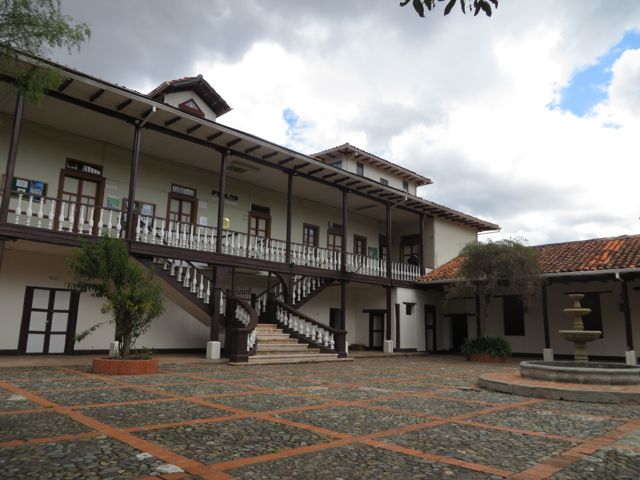
I’m one of those lucky people who, mostly, enjoys my job. Given how much time I spend working, that’s a good thing. So, for this installment of ‘Favorite Spots in Cuenca’, I felt I had to mention the place in Cuenca where I spent the most time (other than the house where I lived): The Quinta Balzay, a satellite campus of the University of Cuenca.2015_0721i Continue reading

Oh, wait…What did I just say?

2015_0719a

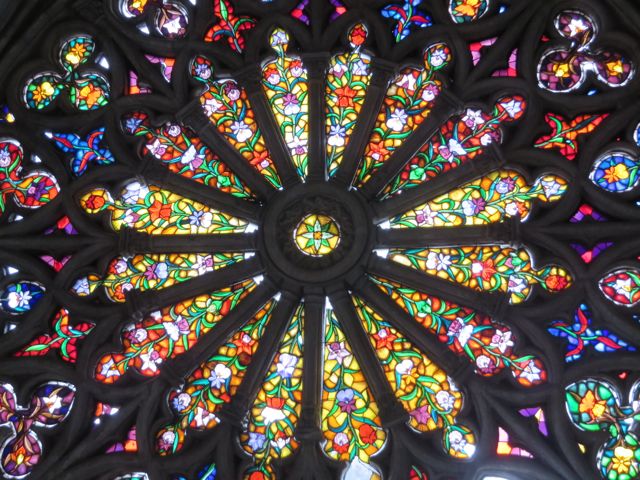
Learning to communicate effectively in another language is like putting together pieces of a mosaic. There are so many little details to consider – sometimes you’re able to see the beauty in the big picture, but you may not understand exactly what it all means. (Photo from the Quito Basilica – Feb 2015)

“I have already lost my meal,” I say as the waitress walks up to the table. I don’t realize what I’ve said until she looks at me a little funny. Of course, I really meant to say, “I have already ordered my meal,” but the Spanish verbs for ‘to lose’ (perder) and for ‘to ask for, or, to order’ (pedir) are too close in my head, and I constantly mix them up. If you’ve spent any amount of time trying to communicate in another language, you’ve certainly had moments of enlightenment where you realize exactly how silly you probably just sounded.

Continue reading

Venturing into the Enchanted Forest of Podocarpus

2015_0711p

Sunrise over the Bombuscaro River in Southern Ecuador. Situated on the eastern foothills of the Andes, this is one of Ecuador’s biodiversity hotspots.

The clouds here hang in thick patches on the sides of the hills. Sometimes they seem to rise right out of the trees, forming only a few feet above the canopy as water vapor from this steamy forest becomes too much for the air to handle. If my trip to Alausí gave me the impression of going back in time, my visit to the Bombuscaro River valley on the northern border of Parque Nacional Podocarpus took me even further back. Let’s just say that it wouldn’t have been much of a surprise to see a dinosaur come crashing through the underbrush.

Continue reading